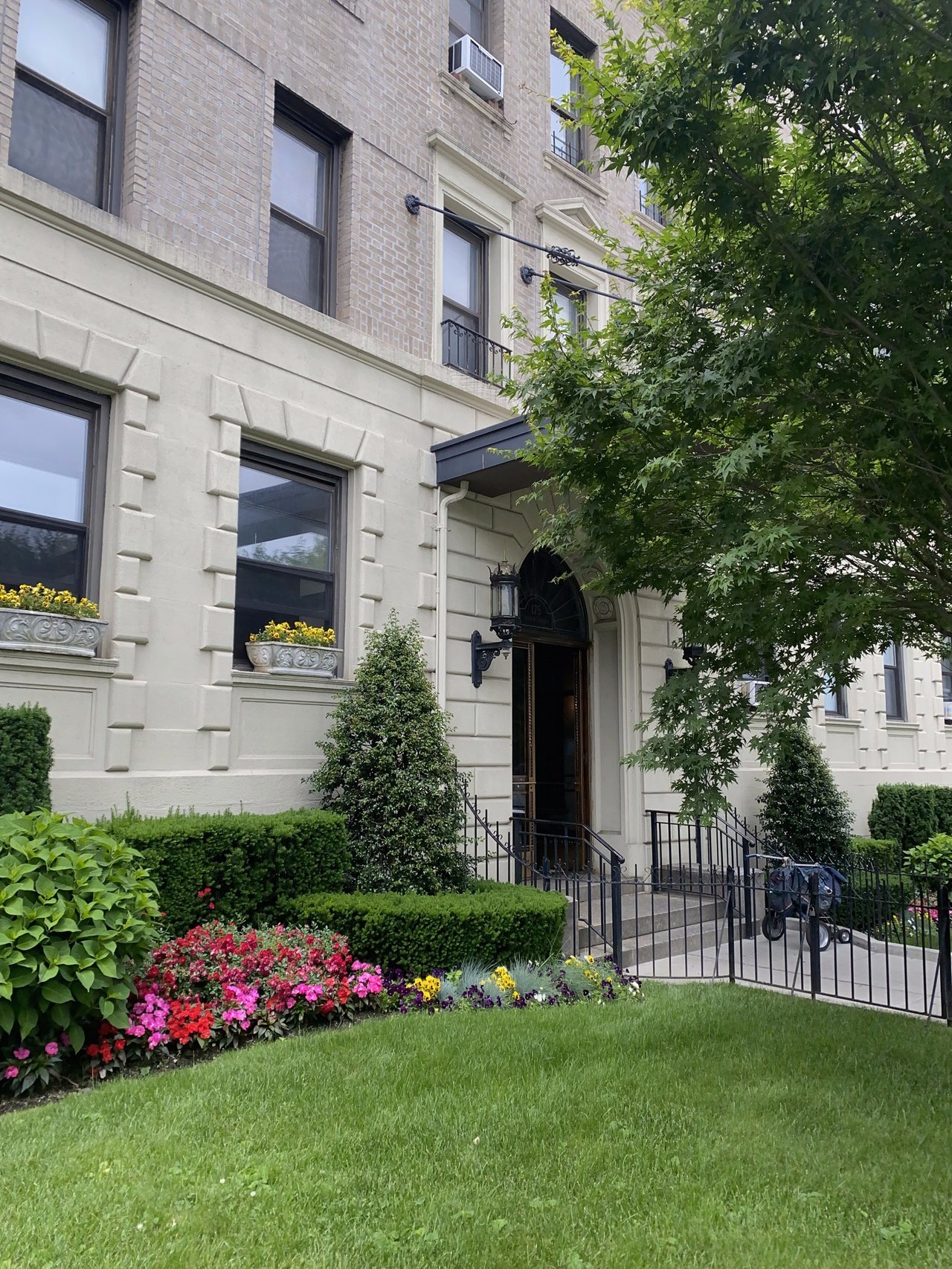
A co-op board package on Fifth or Park Avenue holds the same documents as one anywhere in the city: the building's application, a financial statement, tax returns, bank and brokerage statements, reference letters, signed house rules and consent to a credit check [1]. The numbers are where they differ. The top prewar buildings on Park, Fifth and Central Park West historically wanted all cash, and CooperatorNews reported in October 2025 that some now allow a loan of up to 50 percent of the price [2].
The board exists because a co-op is a corporation that owns the building. You buy shares and receive a proprietary lease on your apartment, and you pay maintenance, the monthly charge for your share of the building's costs. Brick Underground describes the board's job in the application as making sure a buyer can keep paying maintenance even after losing a job [1]. Courts give boards wide room. Under the business judgment rule, which New York's highest court applied to co-ops in a 1990 case involving One Fifth Avenue, judges won't second-guess a board that acts "for the purposes of the cooperative, within the scope of its authority and in good faith" [3]. A board can reject a buyer for any lawful reason without giving one [4]. It can't reject anyone over a protected characteristic, and in New York City the protected list for housing includes lawful source of income [5].
The contract sets the deadline for submitting the package. Nolo says a cash buyer typically has ten business days from delivery of the signed contract, and a buyer with a loan typically has three business days from receiving the commitment letter, the lender's written promise to lend [6]. If the board hasn't decided by the closing date, the standard New York contract allows one 30-day postponement, after which either side can cancel [6].
The board now has a clock of its own. For applications filed on or after July 28, 2026, NYC's Local Law 58 puts co-ops of 10 or more units on deadlines for the first time [7][8]. The board has 15 days to acknowledge the package and say whether it's complete; if it doesn't, the package is deemed complete. It then has 45 days from a complete package to decide, with one 14-day extension, longer only with your written consent, and a July and August recess pauses the clock only if the board has adopted one and told applicants. Fines start at $1,000, and the answer comes back as consent, consent with conditions, or a denial [8]. The full timeline from offer to keys is in how long it takes to buy a co-op.
The financial statement is the center of the package, and it lists every asset and every debt. Brick's advice is to include anything you get a statement for, down to a department store card you haven't used [1]. Habitat reported in 2018 that some reviewers check an account's average daily balance as well as its statement balance, because borrowed money can inflate a snapshot [9].
Two tests come out of that statement. Debt-to-income is all your monthly obligations, including the new loan and the maintenance, divided by your gross monthly income. Brick wrote in March 2023 that a moderate building looks for about 25 percent, and the toughest boards want it below 25 percent and sometimes below 20 [10]. On a household earning $40,000 a month before taxes, 25 percent is $10,000 a month ($40,000 × 25 percent) for the loan, the maintenance and every other debt combined.
Post-closing liquidity is the cash you still hold after the down payment and closing costs. StreetEasy wrote in September 2026 that two years of maintenance, mortgage and other debt payments is relatively standard, and gave a Fifth Avenue example [11]. With maintenance of $15,000 a month and no loan, that is $15,000 × 24 months = $360,000 left over after closing, at minimum. Cash, checking and savings, publicly traded stocks and bonds, Treasury securities, mutual funds and money market funds count. Retirement accounts, real estate, trusts, private stock and Bitcoin generally don't [11]. The full math on a purchase is in how much cash you need to buy.
A co-op wants actual reference letters, personal and professional, where a condo usually asks only for names and contact details [1]. If you're invited to interview, Brick says you can, in most cases, assume the finances have passed [1]. Know your own package, because the questions come from it, and don't leave anything out: a board that finds something held back may decide the buyer was "disingenuous" [1]. The answer usually follows within a few days [12]. What a board may and may not ask is in what a co-op board can ask in an interview. When the answer is a yes with conditions, one Habitat described in 2019 is a maintenance guaranty, often sized at six months to a year of charges [13].
Draft your financial statement before you make an offer. Ask the listing agent for the building's financing limit and whether it publishes a debt-to-income or liquidity test, and run your own figures against them first. If you'd like me to run them with you, email me at [email protected] or call 212-516-4569. The whole purchase, step by step, is in how buying an apartment in New York works, and more on buying is on my buying page.
This is general information, not tax or legal advice.
Ilana Lee, Licensed Real Estate Salesperson, ILNY. Updated November 24, 2026.
Sources
- Brick Underground: How to rejection-proof your NYC co-op or condo application package, January 7, 2025
- CooperatorNews: Condo competition has high-end co-ops relaxing financing requirements, October 17, 2025
- New York State Law Reporting Bureau: Matter of Levandusky v One Fifth Ave. Apt. Corp., 75 N.Y.2d 530, 1990
- Brick Underground: What's the difference between a condo and a co-op in NYC? Which one should you buy?, November 4, 2019
- NYC Commission on Human Rights: The law, accessed November 9, 2026
- Nolo: Co-op purchase contracts: what to watch out for, undated, accessed November 9, 2026
- Pryor Cashman: New NYC law imposes strict timelines on co-op purchase applications, February 10, 2026
- CooperatorNews: Local Law 58: it's about time (and transparency), September 3, 2026
- Habitat: Fiscal Fitness, October 2018
- Brick Underground: What debt-to-income ratio do you need to buy a co-op in NYC?, March 20, 2023
- StreetEasy: Post-closing liquidity for NYC co-ops: what it means and how much you need, updated September 1, 2026
- Brick Underground: How to fill out your board application, undated guide, accessed November 9, 2026
- Habitat: Third-party guarantor can ease co-op sales, November 26, 2019